With a New Budget, Now Californians Brace for the Pain

With a New Budget, Now Californians Brace for the Pain

Thanks to the California state budget that was approved early Thursday morning, my husband and I — relatively new citizens of the Golden State — will help bridge the extraordinary $42 billion deficit next year by paying approximately $1,000 in additional taxes, fees and loss of dependent tax credits. And this figure will remain at that level only if we make no purchases for 12 months in an effort to avoid the new 1-cent-on-the-dollar increase in sales tax.

It is, of course, a better option than getting laid off, not receiving our 2008 tax refund or being unable to drive through an abandoned highway repair project — the brutal realities of a state in freefall with no balanced budget. But it’s still a bit of a shock. “The average Californian hasn’t figured out exactly what this particular budget means for him or her yet,” says Mark Baldassare, president and chief executive officer of the nonpartisan Public Policy Institute of California. “But they’re going to feel it soon.”

Life in California has been rough enough these last three months as government all but ground to a halt while legislators haggled over the long-overdue budget. The state had to send out $3.3 billion in IOU notices to taxpayers and vendors; thousands of construction projects were stalled; and state offices were furloughed. Finally, after a record-breaking 45-hour Senate session, the elusive two-thirds majority vote was reached to pass a budget plan that includes $15 billion in service cuts and spending reductions, $12.8 billion in temporary tax hikes and $11.4 billion in borrowing.

In addition to the increased sales tax, personal income tax rates will go up 0.25% and the dependent credit will drop from $300 to $100. Vehicle owners will now pay an annual license fee that is 1.15% of their car’s value . One increase was avoided. In order to secure Republican Abel Maldonado’s vote, a 12 cent on the gallon gas tax was nixed .

The final budget plan, which Governor Arnold Schwarzenegger signed on Friday, is also dependent on federal stimulus money. California expects approximately $80 billion, although it is not yet clear exactly where this money will be funneled. For instance, if the state determines there is enough money from the federal stimulus package not earmarked for other areas, the personal income tax rate hike could be reduced by half.

There is an irony in passing such a draconian budget in the shadow of President Obama’s recent incentives. “This budget plan has been really counter-intuitive from what people have been hearing about the federal stimulus package,” Baldassare says. “We recognize that here’s a circumstance where the federal government is moving in one direction, which is to encourage [funding] increases and tax cuts to stimulate, and the state is moving in a different direction.” However, Baldassare says he is pleased the state budget is finally balanced: “Getting this budget issue behind us was the most important thing California could do in terms of improving our economic outlook.”

But while the news that Schwarzenegger finally passed a budget — any budget — does come as a relief to politicians and economists who were gravely concerned about credit ratings and business reputation, a long haul is ahead for citizens and businesses already reeling from the foreclosure catastrophe and high unemployment rates. “This is the most serious budget crisis in my lifetime — and I have gray hair,” says Jean Ross, executive director of the nonpartisan California Budget Project. “It will have a significant impact on Californians for the next 18 months and for years to come.”

Some of the biggest spending cuts in the new budget — nearly $10 billion — will hit education and social services. Spending on kindergarten through 12th grade will be reduced by $8.4 billion over the next two years. This means teacher layoffs, fewer school days and more crowded classrooms. Higher education funding will also be cut by $888 million at state schools, where students will be expected to shoulder 10% higher fees. And, according to the new budget, $1.5 billion will be saved by eliminating senior citizens’ annual cost of living increases and other health services .

Not everyone is devastated by the budget’s fine print. It includes tax breaks for large corporations, film companies that keep production in-state, buyers of new homes and small businesses that hire new employees. “The state was about to go over a cliff,” says Allan Zaremberg, president and chief executive officer of the California Chamber of Commerce. “No tax in a recession is a good tax. But I think the legislature and the governor went out of way to spread taxes by as many Californians and businesses as possible so the impact would not hurt any one industry or any one individual.”

Despite the handshakes and smiles yesterday in Sacramento, the budget crisis is far from over — and the state could be in for a serious citizen backlash over the next few months. In California, tax revenue enhancements must be voted on in a special election. On May 19, voters will determine the fate of $5.8 billion in measures, which also include a permanent state spending cap and whether or not to divert money from children’s services, mental health programs and the lottery into state coffers.

In other words, Californians need to brace for another wave of campaigning by politicians and special interest groups. “We’re most concerned about the spending cap that would not just lock us into our broken health care system and prevent us from restoring or reforming, but it would force us to make cuts to existing services in the future,” says Anthony Wright, executive director of the reform-minded Health Access California, who plans to campaign against the proposal.

“It’s very possible that the public will not want to go along with keeping the taxes, and they could vote them out if they don’t vote for the spending cap,” says Tony Quinn, GOP policy analyst and co-editor of the California Target Book. “Most are in favor of a spending cap because the budget is out of balance, but nevertheless, there’s no certainty that will pass. This is a continuation of the political battle.”
Wife of Chinese dissident claims confined during Clinton visit

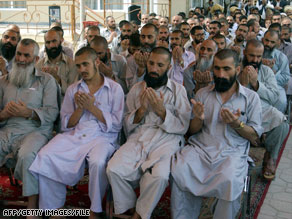
Former detainees pray near Kaubul in 2005 following their release from U.S. custody at Bagram Air Base.
The wife of an imprisoned AIDS activist in China told CNN that Chinese police Saturday confined her to her home during the visit of U.S. Secretary of State Hillary Clinton to Beijing.

“Having considered the matter, the government adheres to its previously articulated position,” said a Justice Department document filed in federal court in Washington. In a controversial 5-4 vote, the Supreme Court last year ruled that detainees held at the U.S. naval base at Guantanamo Bay had a right under the constitution to challenge their continued detention. However, the court did not say whether it applied to prisoners in other locations abroad, including Afghanistan. Five prisoners held at Bagram Air Base, backed by human rights groups, have gone to court to claim the same rights as the men detained in Guantanamo Bay. The new administration, which was given a month by a federal judge to declare whether the government wants to change its position, has now indicated it will continue to argue that it is against its security interests to release enemy combatants in a war zone. Barbara Olshansky, lead counsel for three of the detainee petitioners, said that the administration’s decision was “deeply disappointing.”

Don’t Miss
Read the Justice Department response

Court: Chinese at Guantanamo can’t be freed in U.S.

Teenage terrorist or confused kid — Gitmo’s youngest prisoner

“We are trying to remain hopeful that the message being conveyed is that the new administration is still working on its position regarding the applicability of the laws of war — the Geneva Conventions — and international human rights treaties that apply to everyone in detention there,” she said. The air base at Bagram, located north of the city of Kabul, houses between 600 and 650 detainees. Most were picked up for suspected ties to terrorism.

Clinton: China and U.S. must have a positive relationship

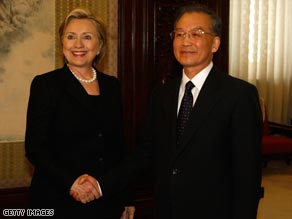
U.S. Secretary Of State Hillary Clinton meets Chinese Prime Minister Wen Jiabao in Beijing Saturday.
U.S. Secretary of State Hillary Clinton met with China’s top leaders Saturday, the last and most crucial stop-over in her Asia trip, signaling the new U.S. administration’s first attempts to lay a foundation towards a China policy.

Clinton met with Chinese President Hu Jintao and discussed the framework for further high-level and mid-level discussions. “It is essential that the United States and China have a positive, cooperative relationship,” Clinton told a group of reporters. Earlier on Saturday, Clinton met with Chinese Premier Wen Jibao in Beijing where they discussed what they regard as the new defining Sino-US strategic goals: the world economic crisis, regional security and the environment. The U.S. and China are the world’s largest emitters of greenhouse gases. Human rights, a traditional topic in discussions between the two countries, was broached during Saturday’s meeting between Clinton and Chinese Foreign Minister Yang Jiechi, who agreed to engage on a continuous discussion on the issue. Clinton said both nations will continue to hold frank discussions on crucial human rights issues, such as Tibet and freedom of expression in China. However, “human rights cannot interfere with the global economic crisis, the global climate change crisis and the security crises,” said Clinton. In a welcoming response, Yang said China was willing to discuss the often contentious subject.

Don’t Miss
Clinton: North Korea can’t drive ‘wedge’ between U.S., South

Analysis:  Stakes high for Clinton visit to China

Clinton in South Korea as missile controversy brews

Special:  China

“Although differences exist, China is willing to conduct the dialogues with the U.S. to push forward the human rights situation on the premise of mutual respect and noninterference in each other’s internal affairs,” Yang was quoted in the Chinese Xinhua news agency. On the economic front, both leaders emphasized the importance of working in cooperation as their economy is intertwined. Yang said that China, the world’s top holder of U.S. debt, wants to ensure liquidity and security in its dealings with U.S. treasury bonds. “We did use foreign exchange reserves to buy U.S. treasury bonds. Our principle of using reserves is to ensure security and liquidity,” Yang told reporters. China-U.S. trade volume rose by 10.5 percent in 2008 to $333.7 billion, Xinhua reported. Beijing is Clinton’s last stop in her Asia trip, her first as Secretary of State. According to the Council on Foreign Relations, China is North Korea’s largest trade partner. It has taken a leadership position in the six-party talks, a multinational diplomatic effort to denuclearize North Korea. In Seoul, Clinton did not refrain form harsh words, restating the U.S. position towards North Korea. “North Korea is not going to get a different relationship with the U.S. while insulting and refusing dialogue with the republic of Korea,” she said. Mid-level military discussions will resume this month, Clinton announced Saturday. Last October, the Bush administration notified congress of its plan to sell $6.5 billion in arms to Taiwan which caused China to suspend military talks with the US.

Clinton told CNN’s Senior Correspondent Jill Doughtery that U.S. policy towards Taiwan will not change. Chinese President Hu Jinato and U.S. President Barack Obama are scheduled to meet at the G20 meeting in London in April.

Arrests in India after hepatitis B kills 32

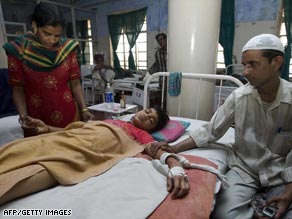
Hepatitis-B patient Mahir Husain, center, is comforted at The Civil Hospital, Ahmedabad, Wednesday.
Authorities were carrying out raids at medical stores in India’s western Gujarat state for bogus drugs and recycled syringes after a hepatitis B outbreak left 32 people dead, officials said Saturday.

Five medical practitioners were also arrested for violations, said Malayappan Thennarasan, the top administrator of the state’s Sabarkantha district. One of those arrested is being held for allegedly reusing injection syringes, Thennarasan said. Health authorities have recorded 111 cases of hepatitis B infection in the district over the past two weeks, he added. “Of them, 32 have died,” he said. Health officials have launched an awareness campaign in the district, Thennarasan said this week. Hepatitis B is a contagious liver disease resulting from infection with the hepatitis B virus, according to the U.S. Centers for Disease Control and Prevention. It usually spreads through blood, semen, or other bodily fluids, often through sexual contact or sharing needles or syringes with an infected person, the CDC says. The disease can range from a mild illness lasting a few weeks to a serious, chronic illness resulting in long-term health problems or death, according to the CDC.

Police may be close to arrest in Chandra Levy case

Police are reportedly close to making an arrest in the Chandra Levy murder case.
Police are close to making an arrest in the Chandra Levy murder case, one of Washington’s most infamous cold cases, CNN affiliate KGO reported Saturday.

Police contacted Levy’s parents Friday informing them the arrest was imminent, the San Francisco, California, television station reported. KGO also quoted a Washington television report that said police were pursuing an arrest warrant for Ingmar Guandique, an inmate in the D.C. prison system. Washington police did not return calls to CNN seeking comment. “We appreciate all the hard work they did,” Susan Levy, Chandra’s mother, told another CNN affiliate KXTV. “You want justice. You want the person incarcerated. It is still painful no matter what. Your child is dead and gone. But we are glad the police are doing something and making a difference.” Levy, a California native, went missing on April 30, 2001. Her remains were found May 22, 2002, by a man walking his dog in a remote area of a Washington city park. The search for Levy and massive publicity that accompanied it was largely a result of her connection to Rep. Gary Condit, D-California. Condit has said publicly that he had a friendship with Levy, but police sources said he told them the two had a romantic relationship. Police questioned Condit several times in connection with the murder, but never named him a suspect. Guandique was mentioned in a Washington Post investigation into the unsolved murder published in 2008. The newspaper quoted former investigators in the case who said Guandique assaulted two other women in the park where Levy’s body was found. Guandique admitted seeing Levy in the park, the newspaper reported.

Israel claims woman hurt in rocket attack

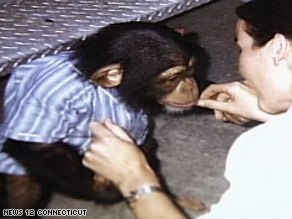
Travis, seen here as a younger chimp, was fatally shot by police after attacking Nash, authorities say.
A woman was injured Saturday when a rocket landed in northern Israel, a spokesman for the Israeli police said.

Charla Nash, 55, was in critical but stable condition Friday with “severe trauma to her face, scalp and hands” at the clinic, Dr. Daniel Alam, a facial and plastic and reconstructive surgeon, said in a written statement. It was at the famed institution in December that surgeons performed the nation’s first face transplant. Nash was flown Thursday in the clinic’s private air ambulance from a hospital in Stamford, Connecticut, where she had been taken Monday in the immediate aftermath of the attack. “It’s way too early to tell if she’s a candidate for a face transplant,” a hospital spokeswoman said Thursday. She said doctors at the clinic would consider that procedure only after ruling out all other options. Nash’s ordeal began Monday, when her friend, Sandra Herold, 70, called and asked her to help get her escaped 14-year-old chimp back into her house.

Don’t Miss
Chimps dangerous pets, humane society says

Chimp attack victim moved to Cleveland Clinic

When Nash arrived at the Stamford home of her friend, the chimp, who has been featured in TV commercials for Coca-Cola and Old Navy, jumped on her and began biting and mauling her, police said. Nash underwent seven hours of surgery at Stamford Hospital. A Stamford police officer fatally shot the nearly 200-pound chimp. Herold told reporters that she and the chimp slept together and that she considered him like a son.

Doctors weigh chimp victim’s course of treatment

Travis, seen here as a younger chimp, was fatally shot by police after attacking Nash, authorities say.
A team of doctors at the Cleveland Clinic will spend as much as a week determining how they will treat a woman mauled by a chimpanzee, and whether they will consider offering her a face transplant.

Charla Nash, 55, was in critical but stable condition Friday with “severe trauma to her face, scalp and hands” at the clinic, Dr. Daniel Alam, a facial and plastic and reconstructive surgeon, said in a written statement. It was at the famed institution in December that surgeons performed the nation’s first face transplant. Nash was flown Thursday in the clinic’s private air ambulance from a hospital in Stamford, Connecticut, where she had been taken Monday in the immediate aftermath of the attack. “It’s way too early to tell if she’s a candidate for a face transplant,” a hospital spokeswoman said Thursday. She said doctors at the clinic would consider that procedure only after ruling out all other options. Nash’s ordeal began Monday, when her friend, Sandra Herold, 70, called and asked her to help get her escaped 14-year-old chimp back into her house.

Don’t Miss
Chimps dangerous pets, humane society says

Chimp attack victim moved to Cleveland Clinic

When Nash arrived at the Stamford home of her friend, the chimp, who has been featured in TV commercials for Coca-Cola and Old Navy, jumped on her and began biting and mauling her, police said. Nash underwent seven hours of surgery at Stamford Hospital. A Stamford police officer fatally shot the nearly 200-pound chimp. Herold told reporters that she and the chimp slept together and that she considered him like a son.

Netanyahu: Iran top threat in Israeli history

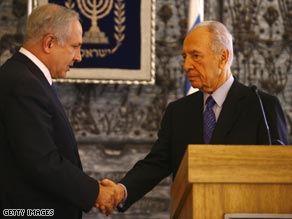
Netanyahu (left) shakes hands with Peres, who has asked him to form the next Israeli government.
Benjamin Netanyahu, the head of the conservative Likud Party, has been chosen to form Israel’s next government, Israeli President Shimon Peres announced Friday.

At a joint news conference with Peres, Netanyahu said he accepted the task and he is willing to work with the moderate parties of Labor, led by Ehud Barak, and Kadima, headed by Foreign Minister Tzipi Livni. “We have different approaches in different areas, but we are all together in our desire to act for the good of the state,” Netanyahu said. “We will be able to find the common ground to lead the state toward security, prosperity and peace.” He said Israeli leaders need to unite as the country faces “great challenges,” particularly from Iran, which he said “is developing nuclear weapons and poses the biggest threat to Israel since the war of independence.” A U.N. report released this week found that Iran has enough uranium for a single nuclear weapon, but the uranium has not been enriched to make it weapons-grade. Iran consistently has denied the weapons allegations, calling them “baseless,” and said that data that indicated otherwise was “fabricated.” To become Israel’s next prime minister, Netanyahu must form a coalition within six weeks, or the process will start all over. The decision comes after Avigdor Lieberman, head of the right-wing Yisrael Beytenu party, said he would recommend Netanyahu for the post, but only if he promises to form a “broad-based” coalition government.

Don’t Miss
Iran ready to build nuclear weapon, analysts say

Analysis: Mixed message for peace

In Depth: Israel votes

In last week’s parliamentary elections, no single party won the minimum 61 seats needed to form a government. That means a government of two or more parties — or coalition government — is inevitable. Watch election analysis from CNN’s Bill Schneider » The ruling Kadima Party won the most seats in the Knesset, Israel’s parliament. But Kadima received just one more seat than Netanyahu’s Likud Party. The strong showing of other right-wing parties — including Yisrael Beytenu and the Orthodox Shas movement — could give Netanyahu a better chance of forming a coalition government. Speaking to fellow Likud members Monday, Netanyahu expressed confidence that he has enough support to emerge as Israel’s next prime minister. “I plan to form a government as soon as possible with our natural partners,” the former Israeli prime minister said. “We have a government in our hands, but we want a broader one.” He added that he will negotiate with other parties, including Kadima, “to form a broad national unity government.” Livni took over as Kadima leader after Prime Minister Ehud Olmert stepped down from the post amid corruption investigations. Livni’s failure to assemble a ruling coalition at that time triggered last week’s elections. Netanyahu, 59, is a former Israeli soldier who served in the elite commando unit Sayeret Matkal. He was one of a dozen Israeli commandos who stormed a Belgian aircraft hijacked by Palestinian terrorists in 1972 and helped rescue 140 hostages. After his stint as prime minister from 1996 to 1999, he served in the Cabinet of Prime Minister Ariel Sharon, then Likud Party leader, but resigned in 2005, saying he disagreed with Sharon’s plan to remove Israeli troops and settlements from Gaza. Sharon left Likud and formed Kadima as a more centrist party. Netanyahu has supported the expansion of Israeli settlements on the West Bank and has opposed making further territorial concessions in hope of ending the decades-old Israeli-Palestinian conflict. He has been reminding the public that he warned that Palestinian militants in Gaza could launch rockets at Israeli cities such as Ashkelon and Ashdod — which has happened and led to Israel’s recent military operation in Gaza.

His Likud Party had a strong showing in last week’s election, more than doubling the number of seats it holds in the Knesset. Netanhayu said that showing proves that voters have rejected Kadima’s leadership, and he predicted right-leaning parties will be able to form a majority. “With God’s help, I shall head the coming government,” he said. “I am sure that I can manage to put together a good, broad-based and stable government that will be able to deal with the security crisis and the economic crisis.”

Slave in Jefferson Davis’ home gave Union key secrets

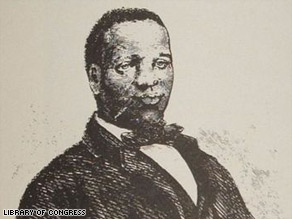
William Jackson, a slave, listened closely to Jefferson Davis' conversations and leaked them to the North.
William Jackson was a slave in the home of Confederate president Jefferson Davis during the Civil War. It turns out he was also a spy for the Union Army, providing key secrets to the North about the Confederacy.

Jackson was Davis’ house servant and personal coachman. He learned high-level details about Confederate battle plans and movements because Davis saw him as a “piece of furniture” — not a human, according to Ken Dagler, author of “Black Dispatches,” which explores espionage by America’s slaves. “Because of his role as a menial servant, he simply was ignored,” Dagler said. “So Jefferson Davis would hold conversations with military and Confederate civilian officials in his presence.” Dagler has written extensively on the issue for the CIA’s Center for the Study of Intelligence . Watch the stories of slaves as spies » In late 1861, Jackson fled across enemy lines and was immediately debriefed by Union soldiers. Dagler said Jackson provided information about supply routes and military strategy. “In Jackson’s case, what he did was … present some of the current issues that were affecting the Confederacy that you could not read about in the local press that was being passed back and forth across local lines. He actually had some feel for the issues of supply problems,” Dagler said. Jackson and other slaves’ heroic efforts have been a forgotten legacy of the war — lost amid the nation’s racially charged past and the heaps of information about the war’s historic battles. But historians over the last few decades have been taking an interest in the sacrifice of African-Americans during those war years. Jackson’s espionage is mentioned in a letter from a general to Secretary of War Edwin Stanton. Maj. Gen. Irvin McDowell refers to “Jeff Davis’ coachman” as the source of information about Confederate deployments. Watch grandson of slaves: “They call me Little Man” » Dagler said slaves who served as spies were able to collect incredibly detailed information, in large part because of their tradition of oral history. Because Southern laws prevented blacks from learning how to read and write, he said, the slave spies listened intently to minute details and memorized them.

Don’t Miss
Holder: U.S. a “nation of cowards” on race talks

Commentary: Holder speech cut through the bull

Commentary: Why Holder’s speech was a failure

In Depth: Commentaries

“What the Union officers found very quickly with those who crossed the line … was that if you talked to them, they remembered a great more in the way of details and specifics than the average person … because again they relied totally on their memory as opposed to any written records,” he said. Jackson wasn’t the only spy. There were hundreds of them. In some cases, the slaves made it to the North, only to return to the South to risk being hanged. One Union general wrote that he counted on black spies in Tennessee because “no white man had the pluck to do it.” No one was better than Robert Smalls, a slave who guided vital supply ships in and out of Charleston Harbor in South Carolina. He eventually escaped and provided the Union with “a turning of the forces in Charleston Harbor,” according to an annual report of the Navy secretary to President Lincoln. “A debriefing of him gave … the Union force there the entire fortification scheme for the interior harbor,” Dagler said. One of the most iconic spies was Harriet Tubman, who ran the Underground Railroad, bringing slaves to the North. In 1863, she was asked by the Union to help with espionage in South Carolina. She picked former slaves from the region for an espionage ring and led many of the spy expeditions herself. “The height of her intelligence involvement occurred late in 1863 when she actually led a raid into South Carolina,” Dagler said. “In addition to the destruction of millions of dollars of property, she brought out over 800 slaves back into freedom in the North.” As the nation marks Black History Month in February, Dagler said that history should include the sacrifices of the African-Americans who risked their lives for their nation. Many paid the ultimate sacrifice. “They were all over the place, and no one [in the South] considered them to be of any value. Consequently, they heard and saw virtually everything done by their masters, who were the decision-makers,” Dagler said. Whatever happened to William Jackson, the spy in Jefferson Davis’s house

Unfortunately, that remains a great unknown. “He simply disappeared from history, as so many of them have.”

Sri Lanka military says it shot down rebel planes

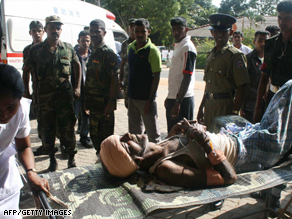
An injured survivor of a suicide attack in northeast Sri Lanka on February 9
Military officials in Sri Lanka said they shot down a Tamil Tiger aircraft near the Colombo International Airport on Friday, in an air engagement with rebels that killed two people and left about 50 wounded.

Sri Lankan officials claimed both planes were shot down by the Sri Lankan Air Force, SLAF, refuting the Tiger’s claim they were conducting suicide missions in the country’s capital. A spokesperson for the Sri Lankan Military said the body of a Tamil Tiger guerrilla was found by the plane’s wreckage after it was shot down near the Colombo International Airport. The other plane, which entered the capital of Colombo, dropped a bomb but crashed into the offices of the Department of Inland Revenue, two blocks away from Air Force Headquarters, a military spokesman said. According to the Sri Lanka’s Lankapuvath news agency, the country’s air defense was activated at 9:30 p.m.( 11 a.m ET) Friday after receiving information that two of the rebels light aircrafts were circulating over Colombo. “Both aircrafts were brought down by air force firing,” Lankapuvath reported. “The dead body of the LTTE pilot was also found strewn about.” The news agency said 50 people were admitted to Colombo General Hospital due to injuries from the crash. Two died from their wounds.

Don’t Miss
Sri Lanka accuses rebels of killing 17 civilians

Sri Lanka says 10,000 civilians flee fighting

Explainer: Sri Lanka and the Tamil Tigers

According to the pro-Tamil Tiger Web site Tamil.net.com, two Black Air Tiger Pilots — the group’s elite squadron –died after carrying out diving missions into Sri Lanka’s air force headquarters in Colombo and an air force base in Katunayaka. CNN could not independently verify the claims made by the rebels or the government. In a report released on Thursday, Human Rights Watch criticized the Sri Lankan government for its “indiscriminate” killings of civilian as it attempts to fight the rebel movement. As the rebel stronghold continues to shrink, civilians are trapped in the cross-fire, HRW said. “Sri Lankan forces are shelling hospitals and so-called safe zones and slaughtering the civilians there,” James Ross, legal and policy director at Human Rights Watch, said in a statement. HRW also condemned the Tamil Tigers for its treatment of civilians.

The organization’s 45-page study said 2,000 civilians have been killed and another 5,000 have been wounded. The Liberation Tigers of Tamil Eelam (LTTE) — commonly known as the Tamil Tigers — have fought for an independent homeland for the country’s ethnic Tamil minority since 1983. The civil war has left more than 70,000 people dead.